
No One Needs Silver or Gold
But You Need Oil & Gas — Every. Single. Day.

This is Part II of my “Silver!” article from February 2024 - which is up almost 160% since then.
The Energy You Can’t Opt Out Of
Let’s start with something uncomfortable:
No one needs silver.
No one needs gold.
No one needs uranium, lithium or rare earths.
Should you have them?
Yes.
Are they smart to hold?
Of course.
Are there a million reasons why you’d want exposure while governments debase and mismanage?
Absolutely. And that will never change in our lifetime.
But the truth is this:
You could never touch a gold coin or a silver bar again and you’d be fine.
Try doing that with oil or natural gas.
Try living a single day without petroleum.
You can’t.
You won’t.
And you’ll never be able to.
A Story From the Beginning
It’s mid 2002.
While my friends back in BC were getting their high school grad photos done, I was already a year into a senior role at the Suncor IT help desk inside Sun Life Plaza in downtown Calgary — the beating heart of Canadian oil money.
That place, that moment, was the origin story:
My first “real” job
My first exposure to markets and wealth
My first understanding of what oil means to a city
And the spark that eventually became a career, a passion, and a worldview
But to truly feel it, you need to understand what Calgary was like back then.
Welcome to the Oil Boom (2002–2008)
The year 2002 ignited a legendary oil boom in Calgary that didn’t cool off until September 2008. If you lived there, you remember:
Ralph Bucks
The Flames’ playoff run and the Red Mile madness
The bars buzzing every single night
Every cabbie, waiter, realtor, and roughneck talking oil prices
Money was everywhere. We all felt rich.
Inside the downtown towers? It was absurd.
Every morning on my desk sat a little yellow form:
Would you like a new IBM ThinkPad or a Palm Treo?
(BlackBerry wouldn’t take over until 2005.)
Need a new laptop?
A new phone?
A new wireless keyboard?
A third monitor?
Just check the box and like magic, it would appear on your desk the next day — still wrapped.
It was that plush.
That abundant.
That surreal.
This was life during a real oil boom.
And here’s the important part:
I believe we’re entering another one — right now.
Not a spike.
Not a rally.
A new cycle.
My Job, My Window Into Wealth
My title was Remote Support Engineer for the Firebag site, later Senior Quality Assurance Analyst. In normal human language: I sat in a beautiful 4th-floor corner office at Suncor’s HQ, listening in on Suncor internal tech support calls from the field and making sure they were handled and dispatched properly.
It was an insanely cushy way for an eighteen-year-old kid with no formal training whatsoever to make $45 an hour.
But the real education didn’t happen on the phone system. It happened in the food court and out in the smoking area.
That’s where the oil bros lived.
Gold Rolexes on their wrists.
911s parked underground.
Suncor stock options in their accounts.
Oil futures on their screens.
I had no idea what half of it meant. But I knew one thing:
They were playing a different game than everyone I’d ever known.
It was like overhearing a secret language — a private code for people who knew how the system really worked.
And I wanted in.
So I started learning.
Futures. Options. Cycles. Scarcity. Energy.
I didn’t just want a gold Rolex and a 911 in the parkade — I wanted to understand the mechanics behind how those things showed up in people’s lives.
That curiosity is what pulled me into silver and gold back in 2005, and eventually into every corner of the market I could get my hands on. But energy? I’ve always been into energy. It’s where everything started for me.
For over 20 years now I have told my friends, who couldn’t have cared less:
“Why complain about gas prices when you can just go long oil futures?”
They didn’t get it.
I am forever grateful that I did.
Fast Forward to Today
This is the follow-up to my silver article from last year. (find it here)
In that article, I talked about why smart people hold precious metals.
Today, I’m telling you something even more important:
If you live in Canada, oil and gas aren’t optional. You burn them daily. Your portfolio should reflect that reality.
Think about it:
When you wake up in your warm home — heated by natural gas — the mattress foam beneath you is petrochemicals.
When you get dressed: polyester, elastics, dyes — petrochemicals.
The water you drink runs through PVC and polyethylene pipes — petrochemicals.
Shampoo, toothpaste, deodorant — petrochemicals.
When you drive: obvious. (Yes, electric cars may run on electricity but are literally made of oil products.)
Every road you drive on? Asphalt — refined petroleum.
Your phone and laptop — petrochemicals.
Every pill, medical device, bandage, and hospital room you rely on — petrochemicals.
When you eat: fertilizers, trucking, packaging — petrochemicals.
Practically every warm building you enter during the day: natural gas.
Streaming Netflix? Data centres run on energy.
There is no modern life without hydrocarbons. None.
Modern life isn’t replacing oil. Modern life is built on oil. So owning oil and gas isn’t “speculation.”
It’s hedging the life you already live.
Global Oil Demand (Still Rising)
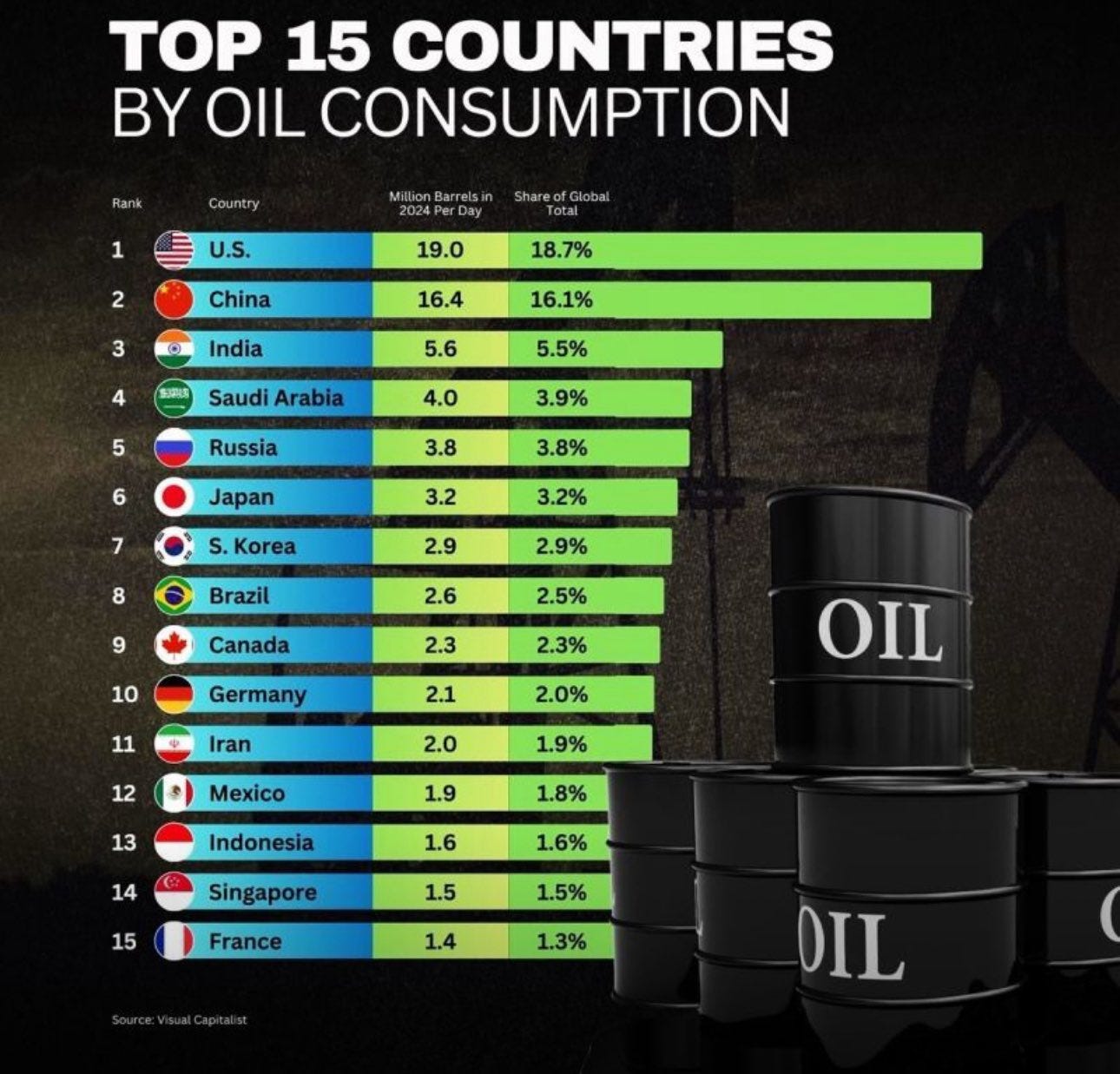
Demand isn’t falling.
Not by 2030.
Not by 2040.
Despite all the headlines, global oil demand is still rising in 2025. The IEA expects consumption to reach roughly 104.4 million barrels per day, with demand growing by another 700,000 barrels per day this year. And here’s the important part: nearly all of that growth is coming from the developing world — the regions that are industrializing, expanding, and consuming more energy every year. In other words, demand isn’t fading, not even close.
The fantasy narratives pushed by activists and clueless academics melt instantly when confronted with data.
Global Natural Gas Consumption

Gas demand is even stickier than oil.
Cleaner.
Cheaper.
Critical for grid stability — and for everything modern life depends on: tech, AI, cyber-security, and beyond.
No wind turbine has ever smelted steel or produced fertilizer.
No solar panel has ever powered a city at night.
But natural gas does all of that — every single day.
And just like oil, global natural-gas demand is still increasing in 2025. The IEA’s latest outlook shows gas consumption rising again this year, driven almost entirely by non-OECD countries — the developing world where populations are growing, cities are expanding, manufacturing is scaling, and electricity demand is exploding. Natural gas remains the backbone fuel for power generation, heating, industrial processes, and fertilizers. In short: gas demand isn’t declining… it’s accelerating everywhere the world is actually developing.
Canada’s Energy Reality
Canada is an energy superpower pretending to be a “transitioned economy.”
Here’s the truth:
We’re sitting on the 4th largest oil reserves on Earth (effectively #2 in the real-world, investable universe.)
We produce some of the cleanest natural gas in the world
Our oil sands produce at stable, predictable, long-life rates
Our companies have massive free cash flow, and dividend yields higher than most REITs
And yet most Canadians have no exposure to the very industry that powers their lives.
This is upside-down in my view.
Why Oil & Gas Belong in Your Portfolio
1. It’s the most inflation-linked sector in existence
Energy can soften during recessions, but over full economic cycles it remains one of the most dependable inflation hedges in existence. When the global economy expands and prices rise, energy prices lead the move — because every good, service, and industry ultimately relies on oil and gas.
2. It’s the only sector you use 30–50 times a day
Every moment of modern life touches energy. You burn oil and gas long before you turn the ignition in your car: when you wake up on a petrochemical mattress, put on synthetic fabrics, eat food grown with fertilizer, use packaged goods shipped by diesel, heat your home, charge your phone, scroll the internet, or stream anything on a device built with petroleum-derived materials.
Name one other investment category that intersects with your life that many times before lunch. There isn’t one.
3. The cult of ESG starved the sector of capital
For nearly a decade, oil and gas became the villain of global finance. Banks pulled back. Pension funds divested. Politicians moralized. Investors fled to tech. The result? Capital dried up, exploration slowed, and new supply barely came online.
But demand didn’t disappear — it kept rising, especially in the developing world. That leaves us with the most predictable setup in commodities: constrained supply meeting relentless demand. And you already know how that story ends. (think silver 2023-2025).
4. Dividends and buybacks are off the charts
Energy companies have grown up. The era of reckless spending and “cowboy drilling” is over. Today’s producers are disciplined, efficient, and obsessed with returning capital to shareholders. They have been forced to be - and its great for investors. With massive free cash flow and some of the strongest balance sheets in the market, they’re delivering record dividends, aggressive buybacks, and real profitability.
In a world where most sectors dilute you, the energy sector pays you.
How the Average Canadian Can Get Exposure
Here are simple, realistic, low-drama ways:
1. Canadian Oil & Gas ETFs
XEG — iShares S&P/TSX Capped Energy Index
The benchmark Canadian energy ETF. Simple, liquid, and gives you broad exposure to the big producers.
HXE — Horizons S&P/TSX Capped Energy (Total Return)
Tracks the same index as XEG but in a tax-efficient total-return structure (no distributions — everything is reinvested internally).
NRGY — Global X Equal Weight Canadian Oil & Gas
An equal-weight approach so you’re not overly concentrated in just CNQ and Suncor. Great for diversification across mid-caps too.
ENCC — Global X Canadian Oil & Gas Covered Call
For readers who want energy exposure plus higher monthly income via covered calls.
Instant diversification. No stock picking required.
2. Large-Cap Producers
Suncor (SU)
Canada’s flagship oil sands producer. Integrated, diversified, and shareholder-focused under new leadership.
Canadian Natural Resources (CNQ)
The gold standard. Low decline, long-life assets, massive free cash flow, relentless buybacks.
Tourmaline (TOU)
The best natural-gas producer in the country. Elite balance sheet, elite assets, elite special dividends.
These companies are cash machines — the core of Canadian energy.
3. Mid-Cap High-Growth Names
Peyto (PEY)
A low-cost natural-gas producer with disciplined management. When gas moves, Peyto moves.
Whitecap Resources (WCP)
Oil-weighted, strong free cash flow, a growing dividend, and serious torque to tightening crude markets.
ARC Resources (ARX)
A top-tier gas and condensate producer with scale, stability, and leverage to LNG megatrends. Exceptionally well-run.
More torque. More upside. More volatility.
These aren’t “sleep well at night” names — they’re “make money when the cycle rips” names.
4. Pipelines (income stability)
Enbridge (ENB)
North America’s largest pipeline and midstream operator. Massive scale, diversified assets, and steady, regulated cash flow.
TC Energy (TRP)
A critical natural-gas pipeline network across Canada and the U.S. Essential infrastructure with long-term contracted revenue.
Pembina Pipeline (PPL)
A reliable, well-run midstream company serving Western Canada’s producers with stable, fee-based income.
These are the toll roads of the energy world. They make money whether oil is $40 or $140.
5. Royalty Companies (sleeper picks)
Freehold Royalties (FRU)
A diversified royalty company with exposure across North America. No drilling, no capex — just collecting cheques from operators on their land.
PrairieSky Royalty (PSK)
One of the largest fee-simple mineral landholders in Canada. Ultra-high margins, pristine balance sheet, and pure royalty exposure.
Zero capex. High margins. Pure oil exposure. A beautifully efficient business model. Personally, one of my favourite ways to get exposure and get paid to wait.
A quick bonus update on my favourite junior in the space: Hemisphere Energy (HME) — the high-torque Canadian junior I own and wrote about for you back in June. Since then, it’s moved steadily higher, up about 20% on price and over 25% with dividends included. A clean little outperformance while very few are paying attention.
I have lots of great US and global options for you to consider, but I’ll save that for another post.
Where This All Leads
The world is not transitioning away from oil and gas.
It’s transitioning away from Biden & Trudeau era fantasy.
Population is rising.
Developing nations are industrializing.
AI will explode electricity and energy demand.
This isn’t a sunset industry.
It’s the backbone of civilization — and it will be for many, many decades.
And just like the early 2000s…
Another boom is forming.
Quietly.
Predictably.
Mathematically.
And almost no one is positioned for it.
Final Word
You don’t need silver.
You don’t need gold.
But you cannot live a single day without oil and gas.
So consider owning some.
Hedge your lifestyle. Hedge that V8 you drive and the fireplace that heats your home.
Invest in the world as it actually is — not how politicians or activists wish it to be.
Because the next oil boom isn’t coming…
It’s already begun.
Or so says the Canadian oil patch this year, quietly, while you weren’t looking:
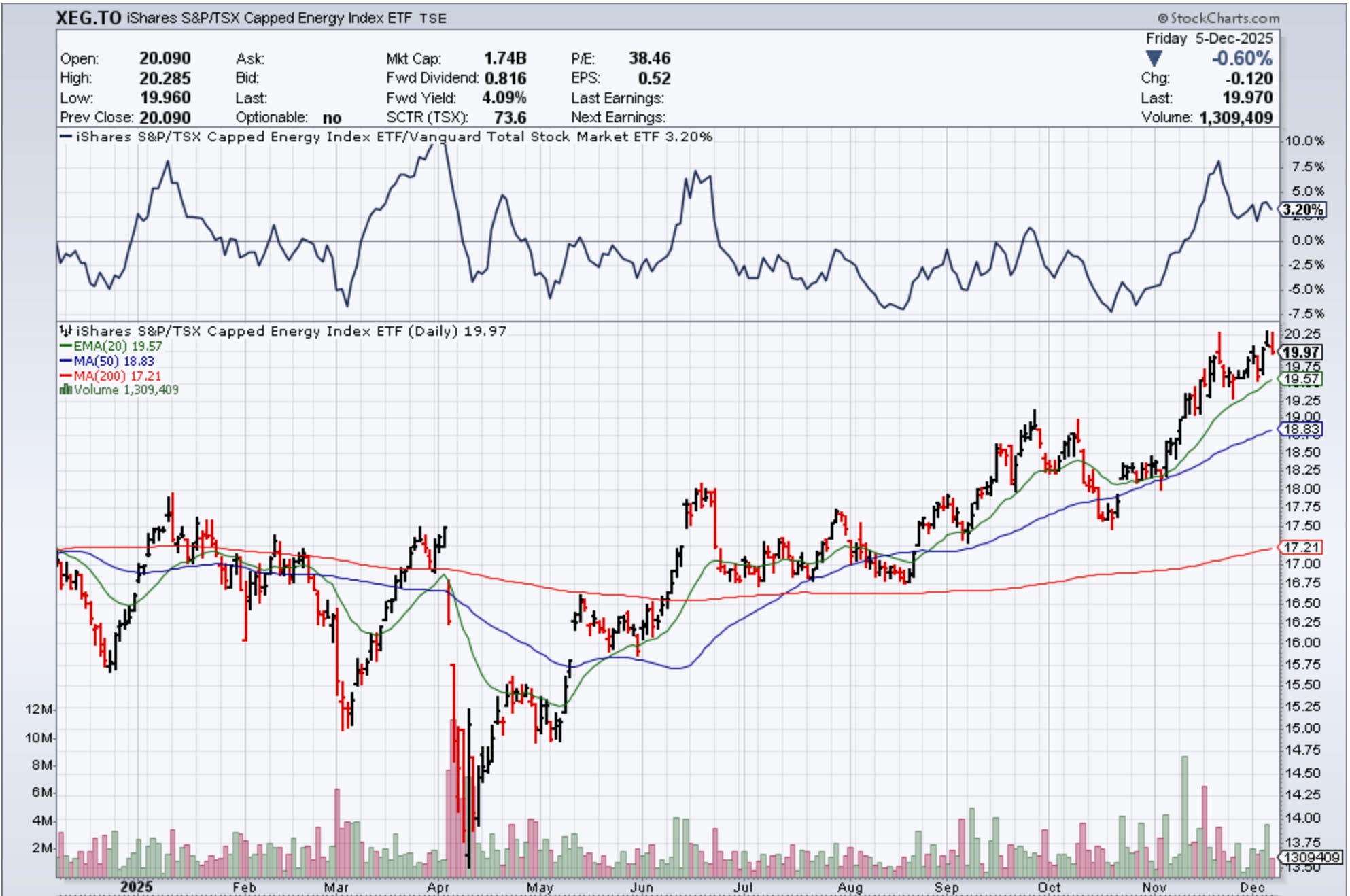
WTI is sitting near $60 and looks ready to move. Silver? Ironically almost the same price.
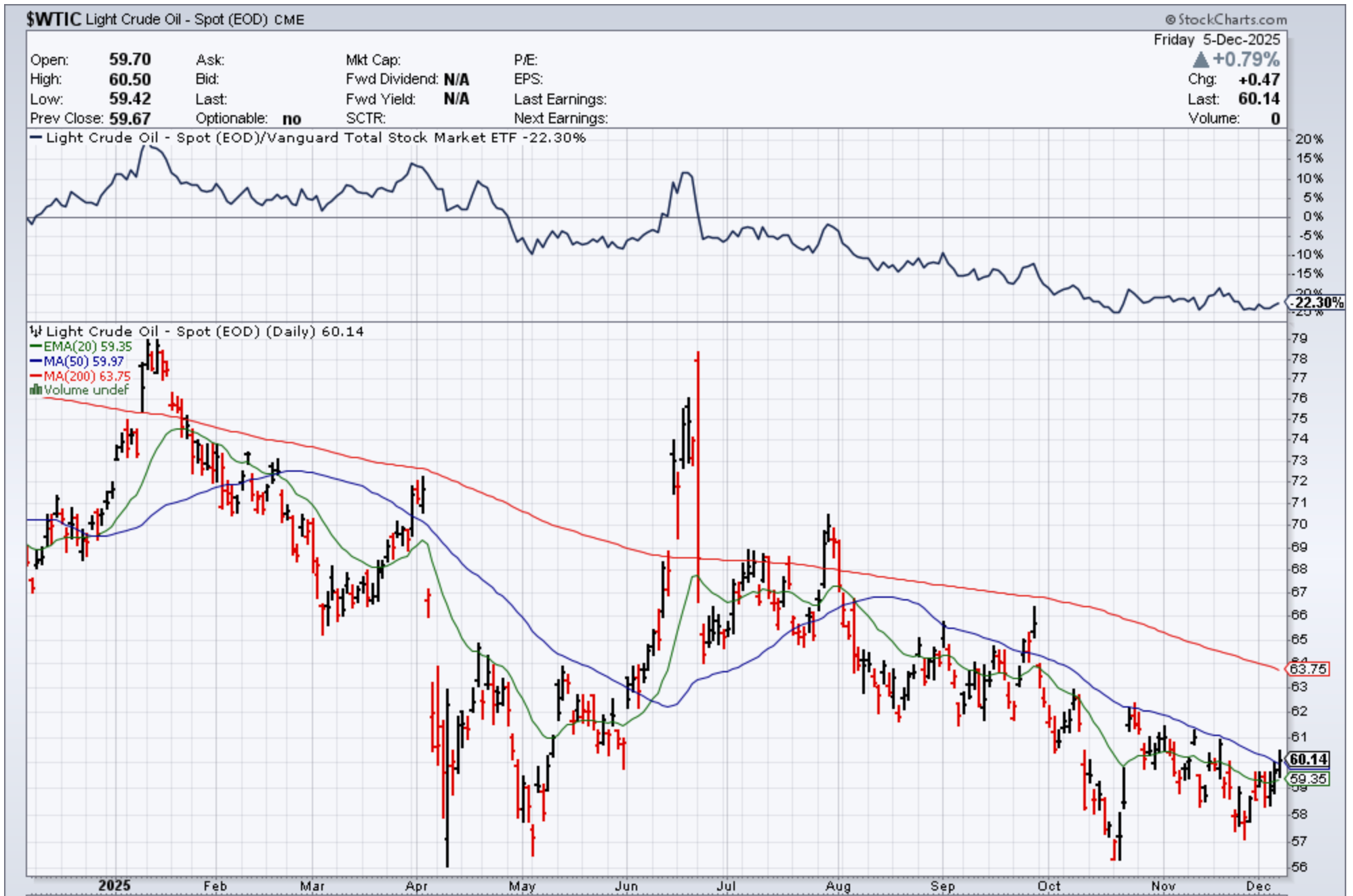
So hold a single ounce of silver in your hand… then picture 42 gallons of crude oil in a full barrel.
Now ask yourself: does that feel even remotely aligned with the actual need the world has for those two things right now?
Because if it doesn’t, then you already know what comes next.
-B
Disclaimer
These writings are signals, not commands. Take them as perspective, not prophecy. I am not an advisor — and never will be. And while many in that profession miss the basics, if you choose to hire one, choose carefully… or keep reading, researching, and learning to trust your own judgment.
I have zero affiliation with any company, stock, or entity mentioned in this article. No compensation, no arrangements.
Your decisions are yours. Your risks are yours. Your outcomes are yours. I offer thoughts, not instructions. Act with intention, question everything, and remember: you live with the results of your choices — not my words.
Buy the dip
Agreed! I've been happy with the Suncor Preferreds I picked up on a recommendation from about 3 years ago.