

One of the most frequent questions I hear is, 'Should I buy silver?' and 'Where/how do I do it?' It feels like everyone is either stumbling across YouTube videos or talking to their barber about silver these last few years, and I am all for it.
Silver represents, in my opinion, one of the best investments of our lifetime for four main reasons:
It's an increasingly in-demand industrial metal, and unlike gold, most silver that gets mined ends up in landfills
It's a precious metal (like gold, platinum, palladium), and it will increase in value against fiat currencies that are eroding
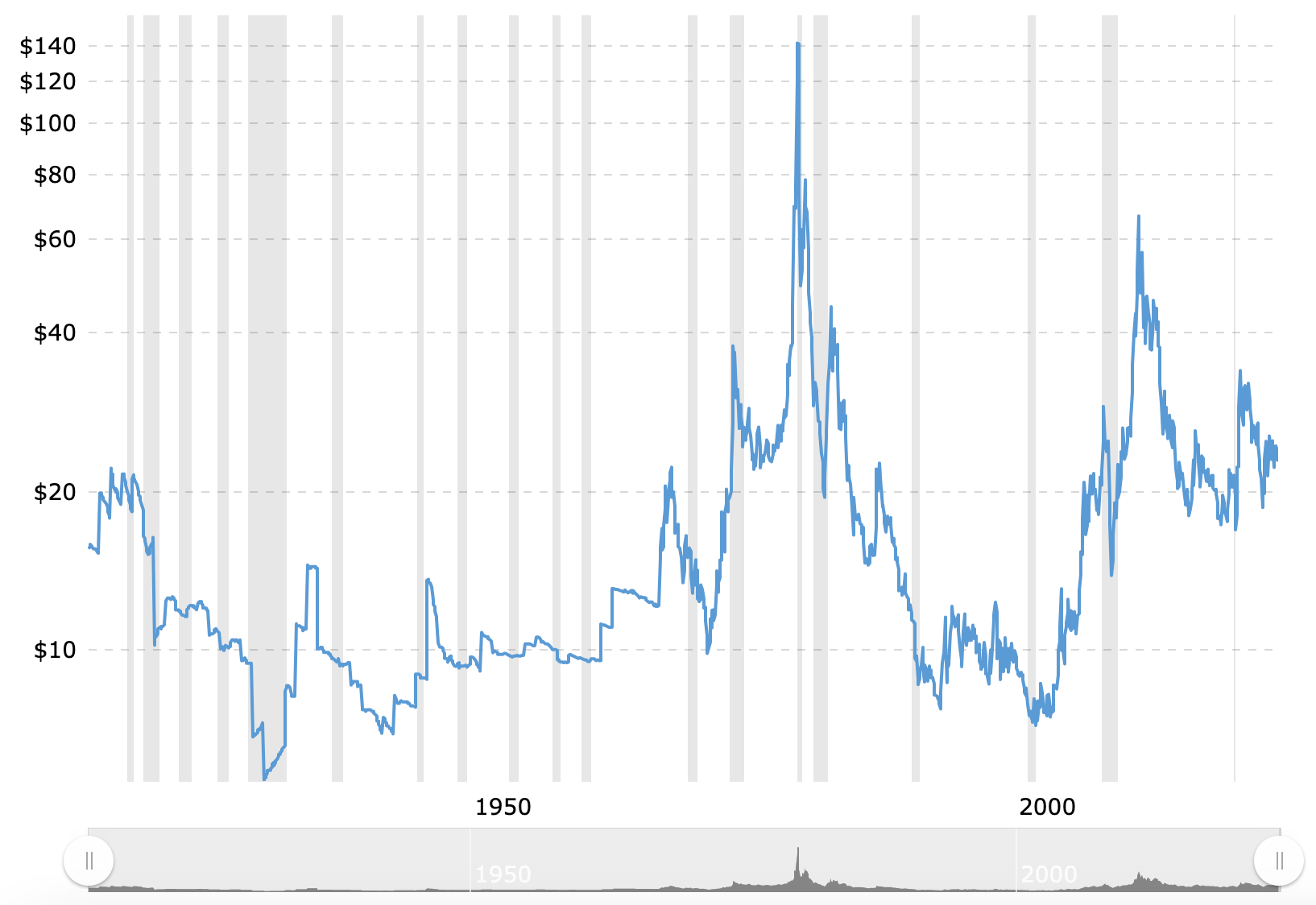
It's historically low when inflation-adjusted - dramatically so and arguably should be closer to $100/ounce rather than today's $23/ounce
Silver’s ratio to gold's price is at an all-time high right now, at about 86:1
What does it mean that it’s an industrial metal?
In short, silver is a critical component in numerous applications, often more than people realize. You could almost make a case that silver has also become a 'consumable’ metal - whereas almost all gold that gets mined remains above ground forever, in vaults, safes or jewellery boxes.
Silver is highly reflective. Refined silver stands out as the most reflective metal on Earth, reflecting over 95% of light. This characteristic makes it a fundamental component in solar panels, microscopes, and telescopes.
Furthermore, silver is the best electrical conductor we have on earth, boasting a perfect score of 100 on a scale of 0 to 100 for electrical conductivity. In comparison, copper ranks at 97, and gold at 76. This makes silver a crucial component in electronics for entities ranging from NASA to Tesla.
Silver's high ductility is another valuable trait, allowing it to be compressed or shaped while maintaining 100% of its structural integrity.
Silver possesses antimicrobial properties. Before the advent of antibiotics, silver was extensively used for antibacterial purposes. It was even applied in the eyes of newborns to combat infections, introduced into water and wine casks to prevent bacterial growth, and in battle, silver foil was wrapped around wounds.
Interestingly, until 1970, all coins were made of silver. Even the word 'silver' directly translates to 'money' in over 14 languages.
What makes silver a ‘precious metal’?
Silver is, in fact, one of Earth's first known metals and has served as money for over 5,000 years.
Merriam-Webster’s Dictionary states that "silver" has been a part of the lexicon since before the 12th century, deriving from the Anglo-Saxon word “seolfor.”
The word "silver" has various meanings as a noun, verb, and adjective. However, its primary definition as an earthly element is as follows:
“A white metallic element that is sonorous, ductile, very malleable, capable of a high degree of polish, and chiefly univalent in compounds, and that has the highest thermal and electric conductivity of any substance.”
This treasured metal has been around for millennia, playing an inextricably important role in civilization.
An ancient saying posits that gold was the money of kings, and silver was the money of gentlemen. The word “silver” is mentioned 320 times in the Bible, and 7 times in the Quran. In the biblical story where Judas Iscariot betrayed Jesus, he did so for 30 pieces of silver.
Historically, one piece of silver represented two weeks of labor, making it a small fortune at the time. Today, a single silver coin represents less than one hour of labor.
How can we consider silver to be “cheap” today?
In terms of dollars, in which silver's spot price is measured, silver appears absurdly cheap. This is primarily because the COMEX trades paper silver in quantities much greater than what is physically available, leading to ongoing price suppression. A spike in silver pricing would signify weakness in the US dollar; I strongly recommend checking out YouTube for more in-depth information on this topic.
Interestingly, the US one-dollar bill used to be redeemable for 1 ounce of silver. The one-dollar treasury note was, in fact, called a 'silver certificate' from 1878 to 1964.
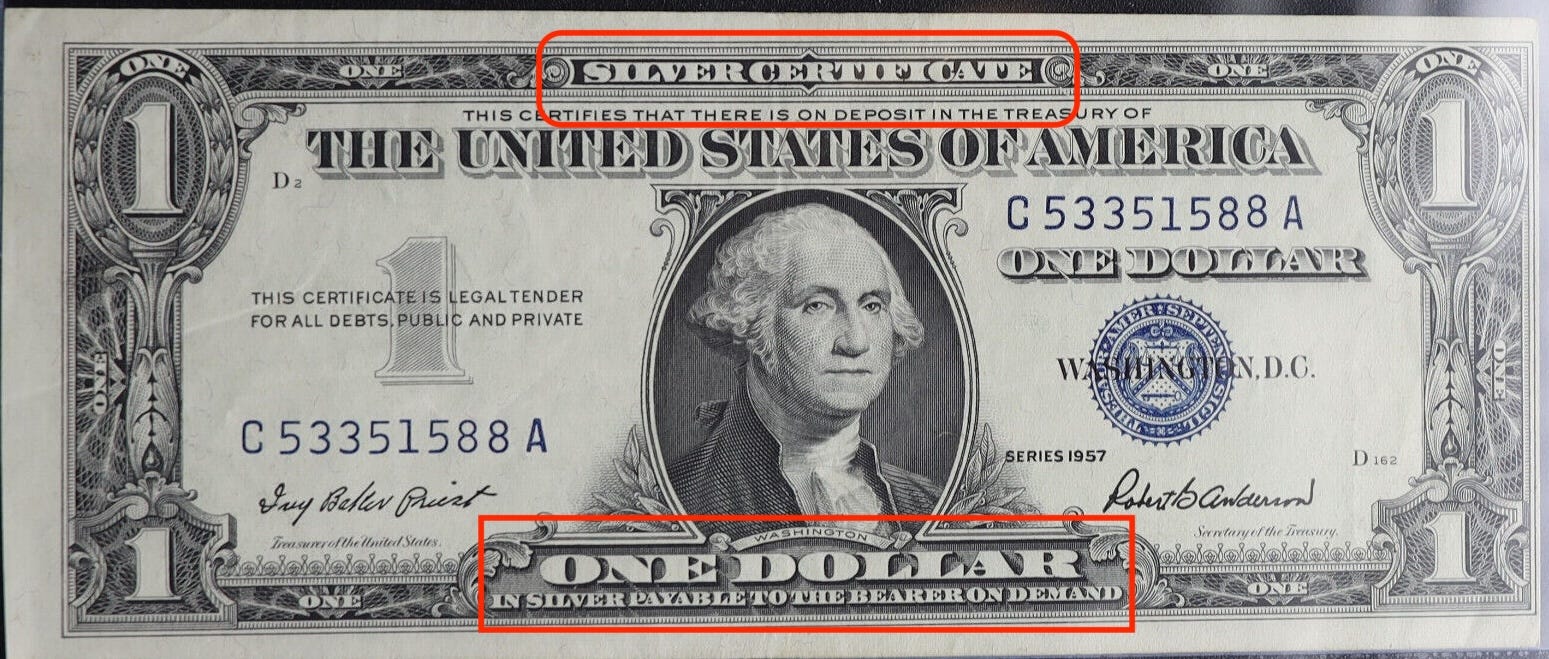
As you can imagine, during the rampant inflation of the 60s and 70s, the US Treasury had to "untether" silver from money to sustain the required amount of dollar printing. There simply wasn't enough silver on Earth to finance the wars that unfolded in the 70’s, 80s, 90s, and 2000s. It's widely argued that the US couldn't have been the war machine it is today if it had maintained the dollar's link to precious metals.
This is why the idea of silver rising above $50 is controversial; it raises questions about the actual strength of the US dollar. Currently, it takes more than 27 dollar bills to purchase one physical ounce of silver, which is valued at about $23 in the spot 'paper' market.
In simpler terms, 27 dollars today is roughly the real, inflation-adjusted equivalent of 1 dollar in the mid-1960’s when measured in silver bullion.
What is the gold/silver ratio and why does it matter?
Here’s a chart that shows golds price relative to silver:
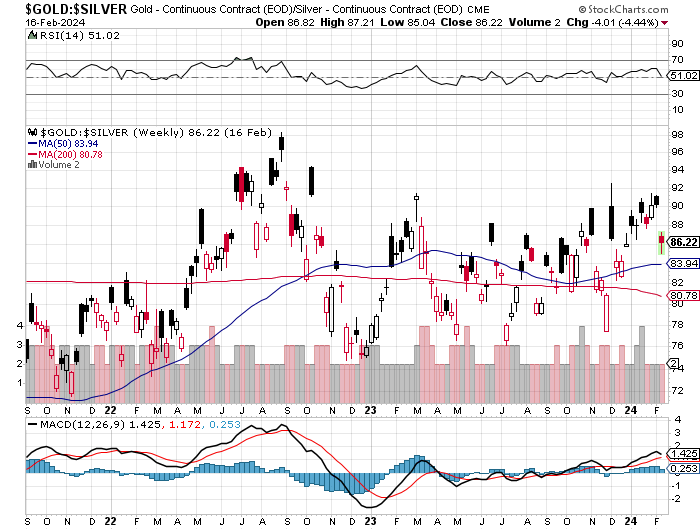
Today, gold is about 86 times more valuable than silver.
What does that mean and why does it matter?
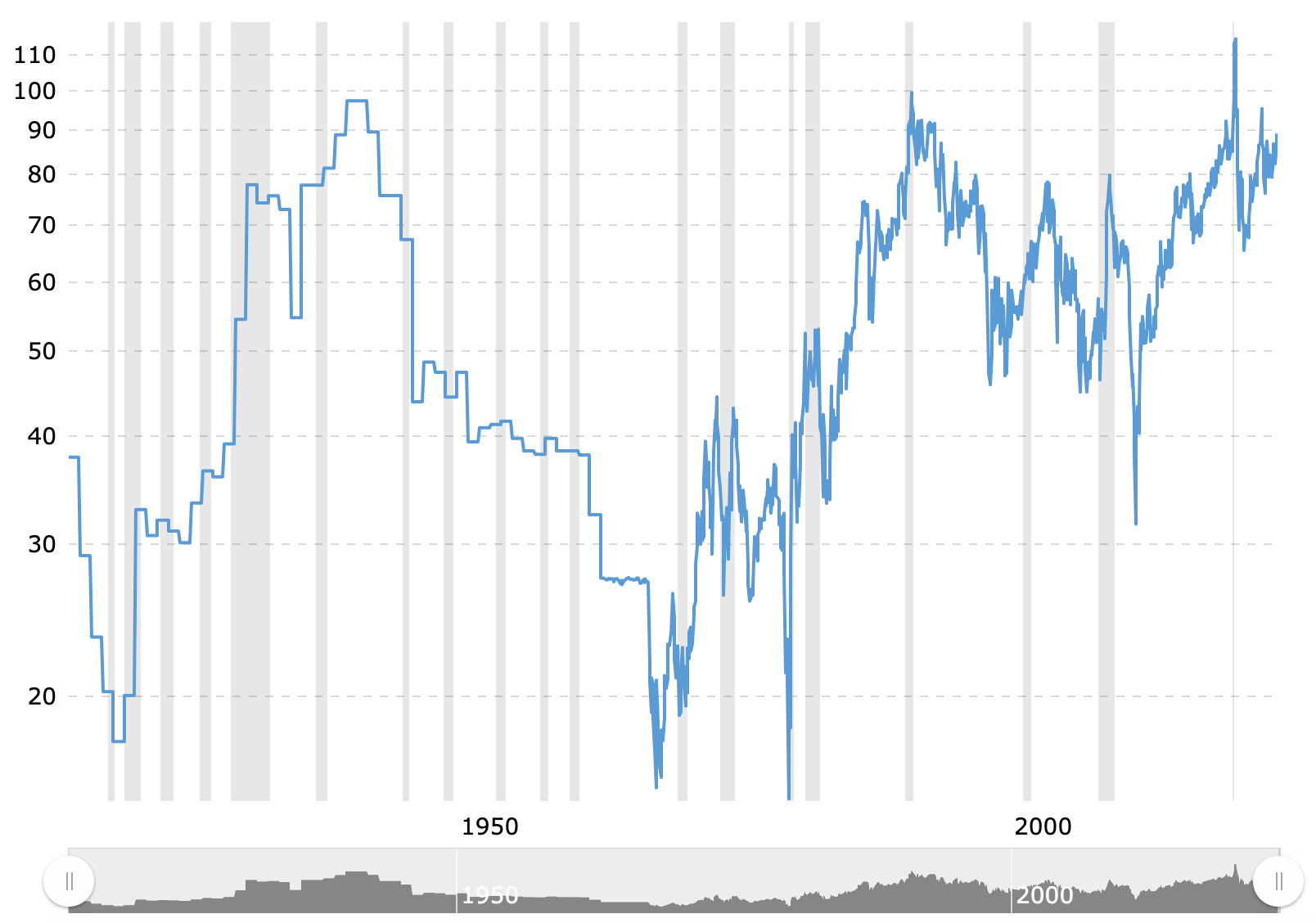
Historically, the ratio has averaged 16:1 for gold being only 16 times more valuable than silver. Here's a look at the last 70 years, with the ratio going below 10:1:
If we zoom out a bit further, going back 300 years, it becomes even more evident how extreme today's 86:1 ratio is:
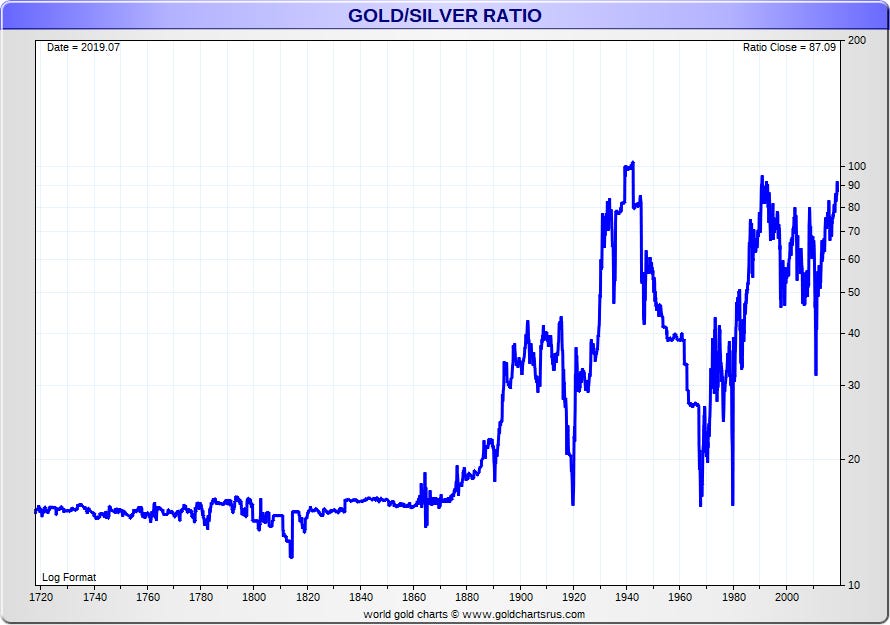
It's notable that something significant happened to the gold-to-silver ratio in the 1920s and again in the 1970s, 80’s and 90’s, largely attributed to the influence of the COMEX - the paper market, known for its price fixing.
Beyond these 'paper prices' of silver, it's crucial to consider the actual ratio of gold vs. silver in the Earth's crust. An indisputable indicator for valuing gold versus silver is the geological composition.
Geologists estimate that there are approximately 19 ounces of silver for every 1 ounce of gold in the Earth's crust. Moreover, the ratio of silver to gold mined historically is around 11.2 ounces of silver to each ounce of gold. Interestingly, in ancient Egypt, the silver-to-gold ratio was 1:1.
Why does this ratio matter?
In simple terms, historically, silver is very, very cheap right now, regardless of the other fundamentals. It is especially cheap when compared to the price of gold today (over $2,000 USD per ounce). Even more-so when you consider it’s underperformance to every other commodity.
So what?
It implies that either gold is going to drop dramatically to close that ratio, or it means silver is going to rise significantly to close that ratio. Given current assessments, it seems unlikely that gold will decrease anytime soon. Therefore, the logical conclusion is that silver has one direction to go from here to close this historic gap.
So what to do? How to buy it?
Should you buy paper or physical? Silver explorers, producers or royalty plays? ETFs or individual names?
Coins or bars? Big denominations or small?
Store at home or in a commercial vault?
All good questions, and there is no standard answer for any of them.
I’ll explain what I do and you can take of it what you will. There are infinite ways to get silver exposure in your portfolio; whether you like to spec on grassroots explore Co’s or buy a basket of major producers in an ETF like SILJ, SIL or SLVP.
I keep it dumb simple… by that I mean I speculate on the price of silver via the Sprott Physical Silver Trust, (no affiliation) buying the dips and selling the rips, and as I sell and make paper gains I roll that into physical gold (1 oz RCM bars).
I also maintain a core position in PSLV instead of keeping cash in the bank. For me, paper silver is my cash, and this strategy has set my approach apart from others, proving quite successful. If I need cash, I sell some PSLV. Conversely, if I have some cash, I convert it to silver and buy more units of PSLV.
I also speculate on a myriad of silver exploration companies - more-so as a hobby and because that’s where the real leverage can come from - if you can handle the losses and the bad operators.
Additionally, I attempt to automate my gold bullion purchases every 30-60 days, storing them with a third party. While you can store it at home, you need to be mindful of numerous challenges around storage and security, and the fact that it's not easily insurable.
The primary reason I buy physical gold instead of physical silver every month is simply due to portability and storage space. You can fit $1 million worth of gold in a briefcase, but you can barely hold $20,000 worth of silver in your arms. To me, gold wins the physical ownership debate simply due to this fact.
Despite this, I am more bullish on the price of silver, as stated above. That's why the majority of my available cash sits in silver with PSLV. When I get profits from selling the paper silver, I roll that into gold as 'house money' that didn't cost me a dime. This way I am also doing forced saving of real assets that are out of sight and out of mind.
And then the fun money, or the play money, goes into junior explore co’s (if you’re also a raving lunatic).
I promise, it works very well.
And don’t get me wrong, I am all for #SilverSqueeze and I am also an ape. I own lots of physical silver, but mainly because it’s just so damn pretty.
Monster boxes of RCM coins are great for SHTF scenarios, and you can’t beat 10oz bars as gifts for friends, because they’re just so cool to hold in your hand. My preferred method for buying physical silver though by far, is 1kg bars. The perfect blend in my opinion of storage vs. real-world-use vs. denomination/cost. The best of all worlds and easy to store/track/inventory as most now come with a unique serial number.
(No affiliation with SilverGoldBull either, just a good option for buying physical)
As for Sprott’s Physical Silver Trust; there is very much a reason I hold that particular ETF over say SLV on the US side (iShares product) or any other competitor.
Primary reason is because with PSLV you actually own your silver. What a concept!
Here’s some critical differentiators from the other silver ETFs from PLSV’s fact-sheet:
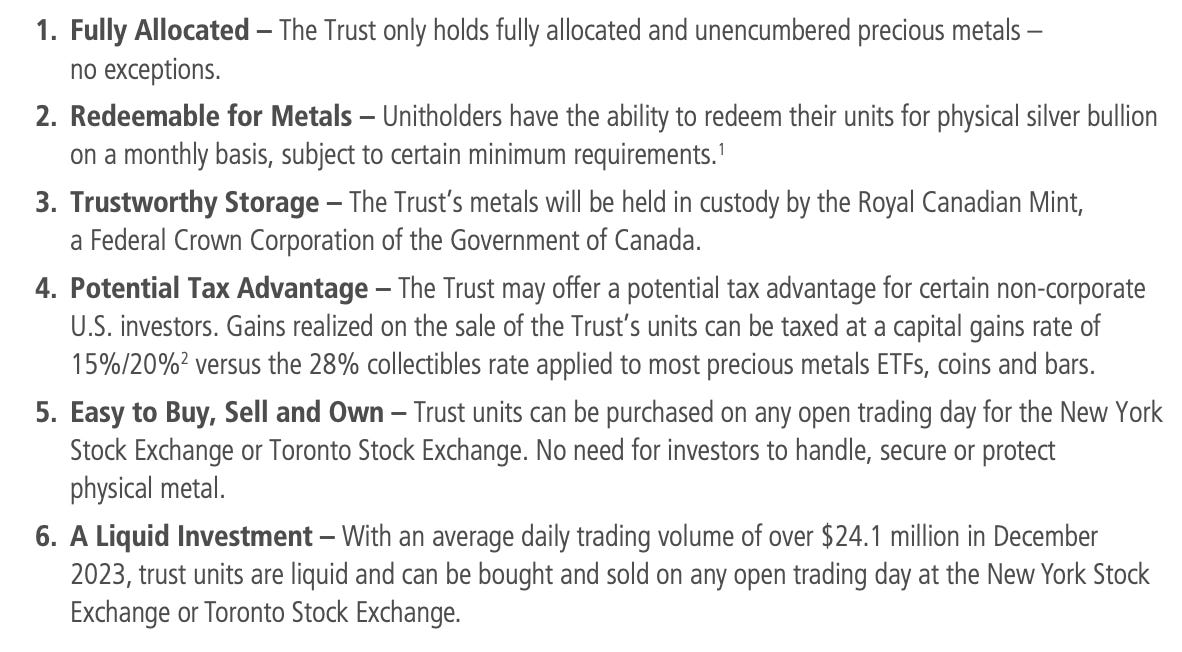
By far the two big factors for you to understand here are:
- You actually own your silver. It is fully allocated/unencumbered and not a derivative (smoke and mirror) product like Blackrock’s SLV where all you own is a contract, not the physical metal itself
- Redeemable for metals; this puts PSLV in a category of one. As fas as I know this is the only silver ETF product on earth where you can take physical delivery in COMEX silver bars by converting your units with your broker, should you wish to do so
And of course this is a more liquid form of silver ownership. When you hold physical bars, they’re not only logistically difficult to go and sell; but you’ll also be subject to big spreads considering that you bought for retail and that your buyer will only give you wholesale pricing back. So if your goal is to be able to get in and out with the click of the mouse rather than a trip to a bullion dealer; an ETF is your best bet.
When you buy physical, your goal should be to hold on to it for at least 5+ years.
A silver ETF lets you trade the metal at home, as you see fit, allowing you to take advantage of pullbacks and weak periods. You also don’t have to worry much about paying a premium with PSLV, as it tracks the actual spot price of silver exactly, minus their 0.59% MER (Management expense ratio).
While all MERs should be scrutinized and avoided wherever possible, this one is a small price to pay to perform along with spot this closely:
(Spot price in blue, PSLV in yellow. You simply cannot do this well with physical.)
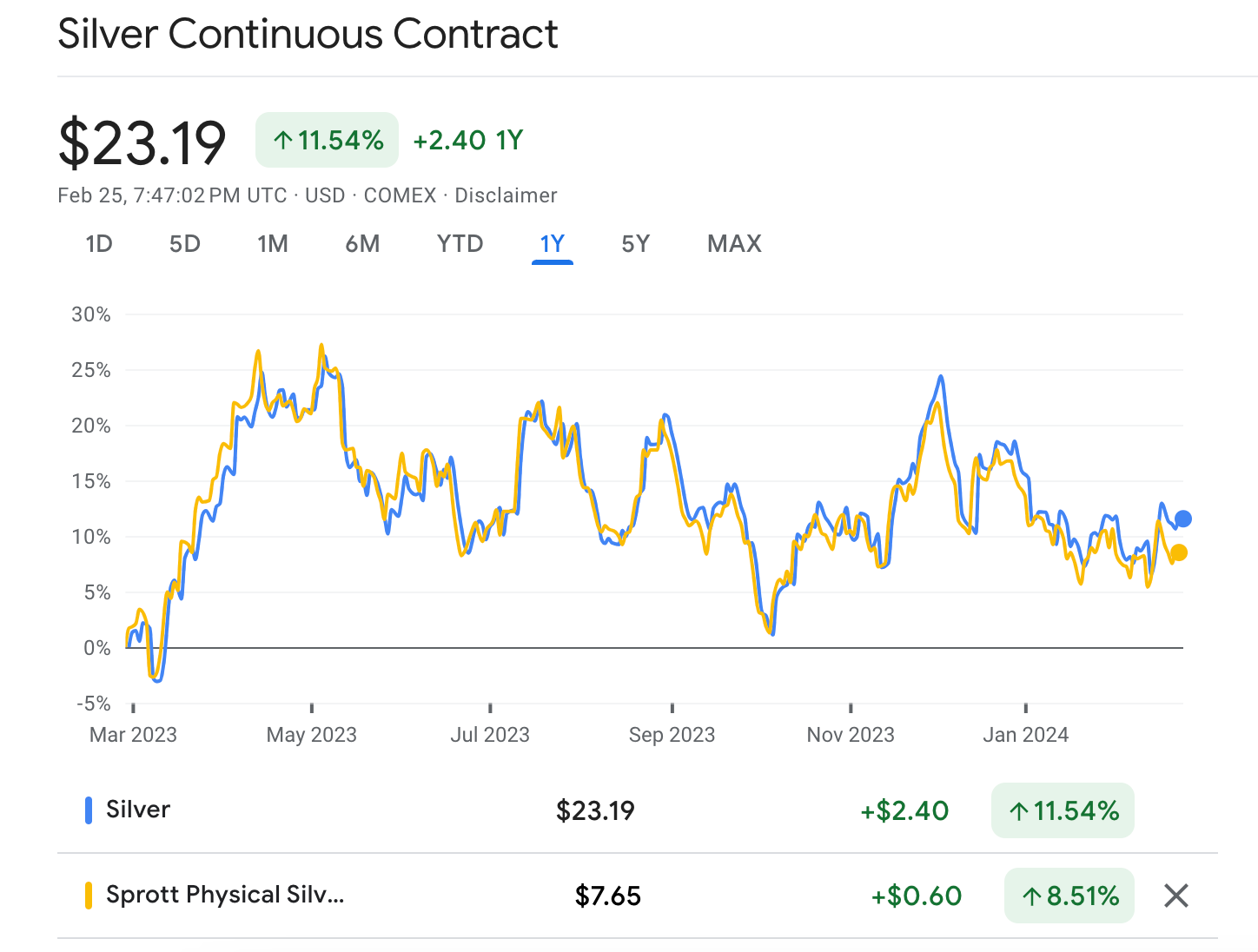
You can see here the correlation, as well as the effect of even a sub-.6 MER over time with the 1-year PSLV performance trailing spot by almost 2 points.
Individual mining and royalty companies
As for picking individual mining or royalty companies, I would say in short, avoid it unless you have some specific reason for owning that company. There are very few silver-only mining companies, as silver is usually mined as a byproduct of companies hunting for other metals. I’ll name-drop what I own and why in an upcoming letter.
If you want mining exposure, pick one of the many Canadian, US or International silver mining company ETFs. A quick google search will give you dozens of great options.
There’s also no shortage of quality streaming and royalty companies if that’s your thing.
Be very mindful that prospecting, exploration, delineation, and mining are four very different things. You’d be shocked at how many people refer to their grassroots prospecting/exploration start-up as a ‘mining company’. This is simply not the case. Find out where you fit in the process, where you’re most comfortable, and ensure at all times that you are very cognizant in the difference between owning shares in a ‘producing’ mining company, vs owning shares in a prospecting start-up. They are literal worlds apart. In fact, usually 15+ years and hundreds of millions of dollars apart. So be very aware of where you are in the process and where you are most comfortable.
Ask yourself; am I more comfortable with renting shares in a start-up, or owning a tiny part of a very difficult business? Both sound about as risky as they are.
So what’s more important to you; return on capital, or return of capital?
If you prefer owning physical gold or silver, remember to think of it more like trading in your disintegrating dollars for something with 5,000 years of experience preserving wealth against bad governance. Think of gold and silver as wealth insurance, as an actual store of wealth. Become a bank, rather than being used by the bank. Gold and silver represent self-insurance without any counterparty risk or fees.
In summary, silver is a pretty badass commodity. It's important for many things, it’s a precious metal, it’s controversial, it’s got 5,000 years of recorded history, and it’s 100-year chart looks absolutely perfect.
You can’t say that about many other investments.
-Brayden
Hi